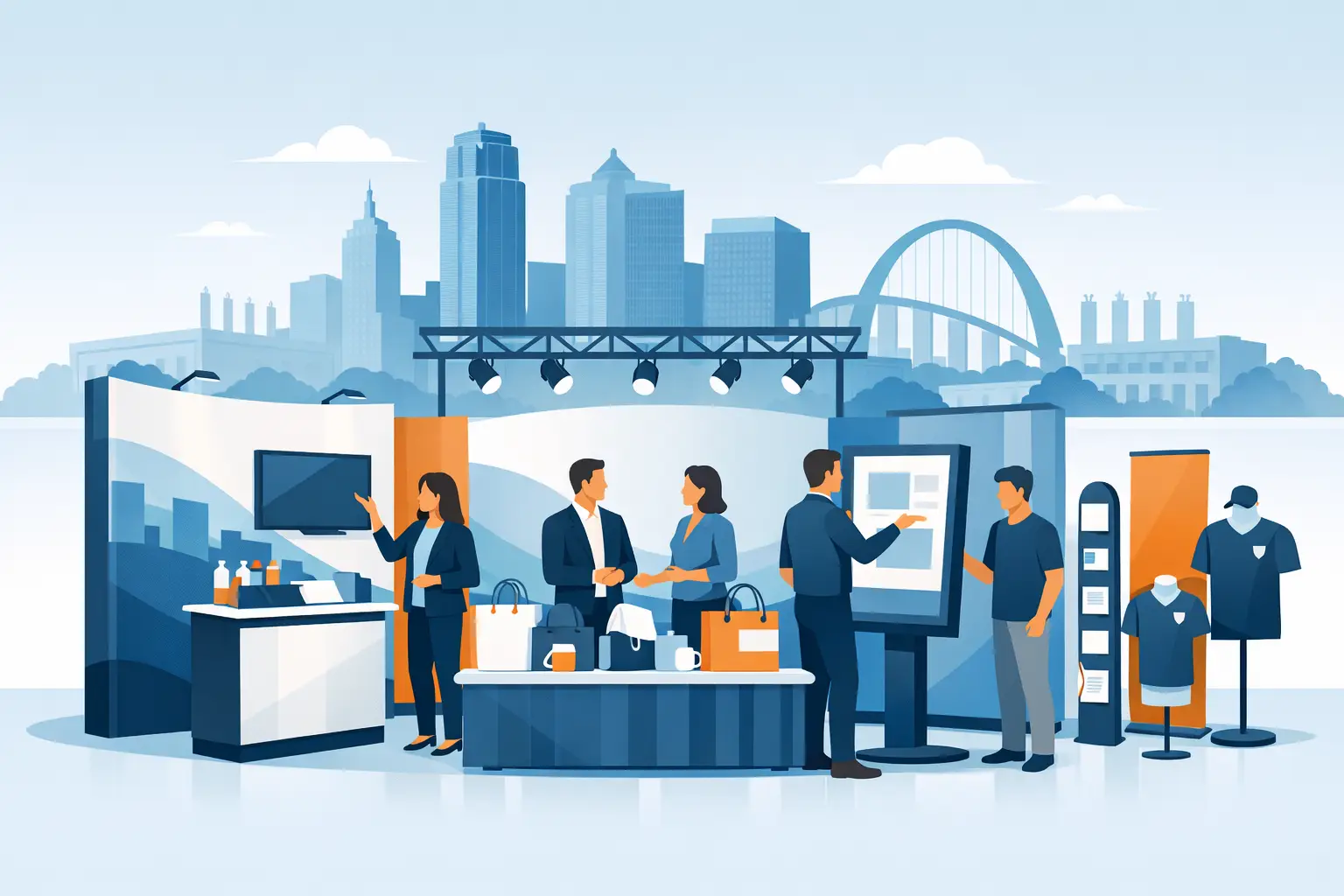
A busy expo floor gives you about three seconds to answer one question for every passerby: why should they stop here? That is what makes kansas city trade show displays more than a backdrop. The right display has to earn attention fast, explain your value clearly, and support real conversations once people step into the booth.
We have seen this across business expos, school recruiting fairs, nonprofit events, chamber gatherings, and community showcases throughout the Kansas City metro. The booths that perform best are rarely the ones with the most pieces. They are the ones built around a clear message, smart layout, and materials that hold up through setup, teardown, and repeat use.
Need Custom Printing or Promotional Products?
Zepher Printing helps Kansas City businesses, schools, teams, and organizations with custom apparel, screen printing, embroidery, promotional products, and branded merchandise.
Request a QuoteWhat Kansas City trade show displays need to do
A good display should make your brand easy to understand from a distance and easy to trust up close. That sounds simple, but many booths miss on one side or the other. Some are visually loud but unclear. Others are informative but easy to overlook from the aisle.
Strong kansas city trade show displays usually do three jobs at once. First, they signal who you are in a quick glance. Second, they guide people toward a next step, whether that is a conversation, a scan, a sample, or a handout. Third, they support your team so the booth feels organized instead of improvised.
That last part matters more than people expect. A display is not just for attendees. It helps your staff know where to stand, where to store materials, where to greet visitors, and how to keep the space from looking cluttered halfway through the day.
Start with the event, not the hardware
Before choosing a banner stand, table throw, back wall, or handout, look at the event itself. A hiring fair has a different goal than an industry conference. A school fundraiser needs a different tone than a municipal outreach event. The most effective booth setup depends on what success looks like for that event.
If your goal is lead generation, the display should quickly explain your offer and remove friction from starting a conversation. If your goal is awareness, visibility and repeated brand touchpoints may matter more than collecting names on the spot. If you are exhibiting at a community event, approachability may be more valuable than a polished but rigid setup.
Venue size also changes the decision. In a compact booth space, one clean backdrop and a branded table setup may outperform a crowded arrangement of stands and accessories. In a larger footprint, adding directional signage, side panels, or freestanding elements can help define the space and draw traffic from multiple angles.
The message has to land from 10 feet away
Most attendees will not read a paragraph on your backdrop. They will scan a headline, notice your logo, catch one or two supporting visuals, and decide whether to keep walking. That is why the best trade show messaging is short and specific.
A strong headline says what you do or what problem you solve without making people work for it. Your graphics should support that message, not compete with it. If everything is bold, nothing stands out.
This is one of the most common trade show mistakes we see. Organizations try to fit their website, brochure, and pitch deck onto one display. The result is usually too much text, too many logos, and not enough visual hierarchy. A better approach is to let the display start the conversation and let your team finish it.
For Kansas City area organizations, local context can help when it is relevant. A school, nonprofit, or municipality may benefit from visuals that reflect the community it serves. A regional business may want to show work that feels recognizable to buyers in Johnson County or across the wider metro. The point is not to force a local reference into every design. The point is to make the display feel connected to the audience in front of it.
Design choices that affect results
Color, image quality, spacing, and material selection all shape how your booth feels. Crisp printing and high-resolution graphics create trust before anyone says a word. That matters for established brands and growing organizations alike.
Readable type is another practical issue that gets overlooked. Thin fonts, low contrast, and dense blocks of text often look fine on a computer screen but fail on a busy event floor. Large, clean typography tends to perform better because people can understand it while moving.
There is also a trade-off between visual impact and flexibility. A highly customized setup can look impressive, but it may be harder to reuse across different booth sizes or event types. A modular display system can adapt more easily and stretch your investment further, especially if you attend multiple events each year.
Fabric backdrops, retractable banners, tabletop signage, branded table covers, and printed handouts all serve different purposes. The best combination depends on your space, budget, transportation needs, and how often your team will be setting up on its own. If your staff needs a quick, repeatable setup, simpler may actually be better.
Don’t treat signage, print, and promo items as separate decisions
Your display works harder when every piece supports the same message. That includes the backdrop, table signage, brochures, business cards, presentation materials, and giveaway items. When these are designed in isolation, the booth often feels pieced together. When they are planned together, the brand feels more credible and more memorable.
This is where working with one local partner can make a real difference. A team that understands your signage, print materials, branded apparel, and promotional products can help you build a booth that looks consistent instead of assembled from four different orders and three different timelines.
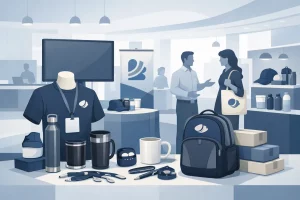
For example, if your staff is wearing branded apparel that matches the display colors and booth graphics, the whole space feels more polished. If your printed leave-behinds repeat the same headline and visual style from the backdrop, attendees are more likely to remember you after the event. If your promotional item connects naturally to your audience and purpose, it becomes a reminder instead of just another freebie.
What to hand out and what to leave behind
Not every event needs a bag full of promotional products. Sometimes a one-page overview and a strong conversation are enough. Other times, a practical branded item helps keep your organization top of mind after a crowded day.
The best giveaway is usually the one that fits the audience and the setting. At a recruiting event, useful branded items and concise printed information can support follow-up. At a business expo, a giveaway that ties back to your service or message tends to perform better than something generic. At a school or community event, family-friendly items and approachable signage may make more sense.
Printed materials still matter, especially when the decision involves multiple people or a longer buying process. A clean rack card, brochure, folder, or sell sheet gives prospects something to take back to the office. It also helps your team stay focused on a few key talking points rather than trying to explain everything verbally.
Setup day reveals every weak point
Trade show planning often feels complete once the artwork is approved. In reality, setup day is where the booth proves itself. Displays that are hard to transport, confusing to assemble, or easy to damage create stress before the event even starts.
That is why practical details deserve attention early. Can one or two people handle the setup? Does the display fit your vehicle or require shipping? Are replacement graphics easy to order if messaging changes? Will the materials still look sharp after multiple events?
Dependable execution matters for organizations that move quickly. A marketing manager preparing for a conference, a school administrator organizing a recruitment table, or a nonprofit team working a community event does not want surprises at 7 a.m. on event day. Fast, local, and done right is not just a slogan in this category. It is what keeps your event investment from getting sidetracked by avoidable issues.
When it makes sense to update your display
If your booth still uses outdated branding, old contact information, or a message that no longer reflects your offer, it is probably time for a refresh. The same applies if your setup looks inconsistent from one event to the next or if your team avoids using certain pieces because they are worn out or inconvenient.
That does not always mean starting from scratch. Sometimes a display just needs new graphics, better print materials, or a smarter combination of signage and branded apparel. In other cases, replacing one oversized or outdated piece with a more flexible system can improve both appearance and ease of use.
Organizations across the Kansas City area often benefit from reviewing the full event package instead of only replacing one item at a time. A booth tends to work better when the display, printed materials, staff apparel, and promo items are planned together around the same goal.
A trade show booth should make your team feel ready, not rushed. If your display helps people understand who you are, invites the right conversations, and holds up from one event to the next, it is doing its job well.