A new-hire polo is needed by Friday. A coach needs 30 extra warm-up shirts midway through the season. A Kansas City nonprofit needs volunteers to order their own event apparel without sending one staff member a spreadsheet full of sizes. These are the moments when the company store vs bulk ordering decision stops being a purchasing detail and becomes an operational one.
Both options can produce quality branded apparel and promotional merchandise. The better choice depends on who is ordering, how often needs change, how much control your organization requires, and whether someone has the time to manage distribution. For many organizations, the most practical answer is not choosing one model forever. It is using each where it works best.
Need Custom Printing or Promotional Products?
Zepher Printing helps Kansas City businesses, schools, teams, and organizations with custom apparel, screen printing, embroidery, promotional products, and branded merchandise.
Request a QuoteWhat Bulk Ordering Does Best
Bulk ordering means one person or department places a single order for a defined quantity of branded products. The organization receives the goods, then handles storage and distribution internally. It is the familiar model for employee uniforms, event shirts, printed materials, customer giveaways, and spirit wear purchased for a specific occasion.
This approach works especially well when quantities and needs are predictable. A construction company ordering safety shirts for a field crew, a school purchasing shirts for an annual fundraiser, or a municipality preparing materials for a community event can plan sizes, artwork, delivery timing, and distribution in one place.
The primary advantage is control. The buyer can review every item before the order is placed, keep branding consistent, and make sure the product mix fits the budget and the event. Larger consolidated orders can also be more efficient when everyone needs the same item at the same time.
When a bulk order is the practical choice
Bulk ordering is usually the right fit for short-term programs and defined groups. Think of a golf tournament, staff appreciation event, trade show, tournament apparel package, or seasonal uniform refresh. There is a clear deadline, a known audience, and a person responsible for getting products into the right hands.
It also makes sense when the product requires more involved decoration decisions. If an organization is selecting a new uniform program, comparing garment samples, or coordinating screen print placement across several items, it is helpful to make those decisions once before ordering for the full team.
There are trade-offs. Someone must collect sizes, estimate quantities, organize deliveries, store extras, and distribute the order. When estimates are off, the organization may be left with unused inventory in unpopular sizes or may need to place a small follow-up order for one missed employee. That process is manageable for occasional projects, but it can become time-consuming when requests arrive every week.
Where a Company Store Adds Value
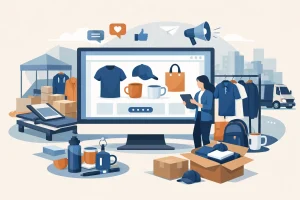
A company store is a controlled online ordering space built around an organization’s approved branded products. Employees, departments, customers, members, or supporters can select from the items assigned to them, using logo files, colors, and decoration methods already approved by the organization.
For organizations with ongoing apparel needs, a store shifts routine ordering away from email chains and spreadsheets. Rather than asking an office manager to gather ten jacket requests, confirm logo placement, collect payments, and sort deliveries, approved users can place their own orders through an established program.
A company store is not simply an online catalog. The value comes from the structure behind it: approved products, consistent branding, defined ordering rules, and a repeatable process. It gives an HR team a reliable way to support onboarding, helps a multi-location business keep apparel consistent, and gives a booster club a more organized way to offer spirit wear.
Common company store use cases
Company stores are particularly useful when requests are frequent, decentralized, or seasonal. Businesses with employees across the Kansas City metro may use a store for replacement uniforms, branded outerwear, employee recognition items, and new-hire apparel. A school district may use one for staff gear or department-approved apparel. Athletic programs may use one for fan wear windows, while nonprofit organizations can offer volunteer or campaign merchandise without requiring staff to process every individual order.
They can also simplify brand governance. When a marketing manager has already approved the shirt colors, logo version, imprint locations, and product selection, individual users do not need to make those decisions again. That protects the brand while making ordering easier for the people who need the products.
The trade-off is that a store needs thoughtful setup. Product options should be useful without becoming overwhelming. Ordering rules, payment responsibility, delivery timing, and access need to be decided up front. A store with too many items or no clear purpose can create confusion rather than save time.
Company Store vs Bulk Ordering: Compare the Day-to-Day Work
The clearest difference is not the product. It is who carries the administrative workload.
With bulk ordering, the buyer manages the process before and after production. That includes collecting requests, approving the final quantity, receiving the goods, and distributing them. This is often efficient when one department owns the project and the order happens once or twice a year.
With a company store, the organization invests time in setting up a repeatable ordering system. After that, individual orders can be placed within the approved framework. This reduces routine administrative work, particularly for organizations that regularly add employees, replace apparel, support multiple locations, or run recurring programs.
Inventory is another important distinction. Bulk orders may require an organization to keep boxes of extra shirts, hats, or promotional products on hand. That can be useful when items are needed immediately, such as welcome kits or event giveaways. But it ties up storage space and can lead to outdated products if branding changes.
A company store can reduce the need to stock every size and style internally. Depending on the program, products may be ordered as needed or offered during scheduled ordering periods. That approach is better for variety and ongoing demand, though it may not be ideal if every item must be available for same-day distribution.
How to Choose the Right Model
Start with the pattern of demand, not the product category. A polo shirt can work equally well in a bulk order or a company store. The right method depends on how that polo will be requested and used.
Bulk ordering is likely the better option if your need has a firm deadline, a known quantity, and one person who can manage distribution. It is especially effective for events, seasonal programs, uniform launches, and large campaigns where everyone needs the same item together.
A company store is likely the better option if orders happen repeatedly, people order from different locations, or brand control is becoming difficult to manage. It is a strong fit for onboarding, employee apparel replacement, multi-department programs, recurring spirit wear, and organizations that want to reduce internal order handling.
Before deciding, ask a few practical questions. How often do requests occur? Who pays for products? Does one person have space to store extras? Are users spread across locations? Is the goal to distribute a fixed set of items or let approved users choose from a defined collection? Clear answers usually point to the right structure.
A Hybrid Approach Often Works Best
Many organizations do not need to treat this as an either-or decision. They use bulk ordering for high-volume, deadline-driven projects and a company store for recurring needs.
For example, an Overland Park business might place a bulk order for a companywide employee appreciation event, then use a store for replacement polos and jackets throughout the year. A school can bulk order shirts for a one-day field event while opening a time-limited store for families who want optional spirit wear. A nonprofit can purchase event signage and volunteer shirts in bulk, then use a controlled store for staff merchandise after the event.
This hybrid model gives teams the efficiency of consolidated purchasing where it matters and the flexibility of ongoing access where it helps. It also prevents a common mistake: building a store for a one-time project or forcing every recurring request into a manual bulk-order process.
Set the Program Up for Long-Term Success
Whether you choose bulk ordering, a company store, or both, start with a clear brand standard. Identify the approved logo versions, colors, decoration locations, and product categories that represent your organization well. A consistent foundation makes every future order faster and easier to approve.
Next, keep product selection focused. A practical apparel program does not need every garment available in every color. It needs reliable options for the roles, seasons, and budgets of the people using them. Quality polos, tees, outerwear, headwear, and promotional items chosen with a purpose will serve an organization better than an oversized catalog.
Finally, work with a partner that understands how the program will be used after the order is placed. Zepher Printing has helped Kansas City-area organizations coordinate apparel, print, signage, and promotional products for more than two decades, and the strongest programs are always built around the organization’s actual workflow.
The best ordering method is the one that keeps your brand consistent, removes unnecessary work from your team, and gets the right products to the right people when they need them.