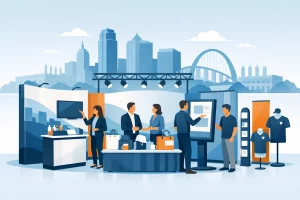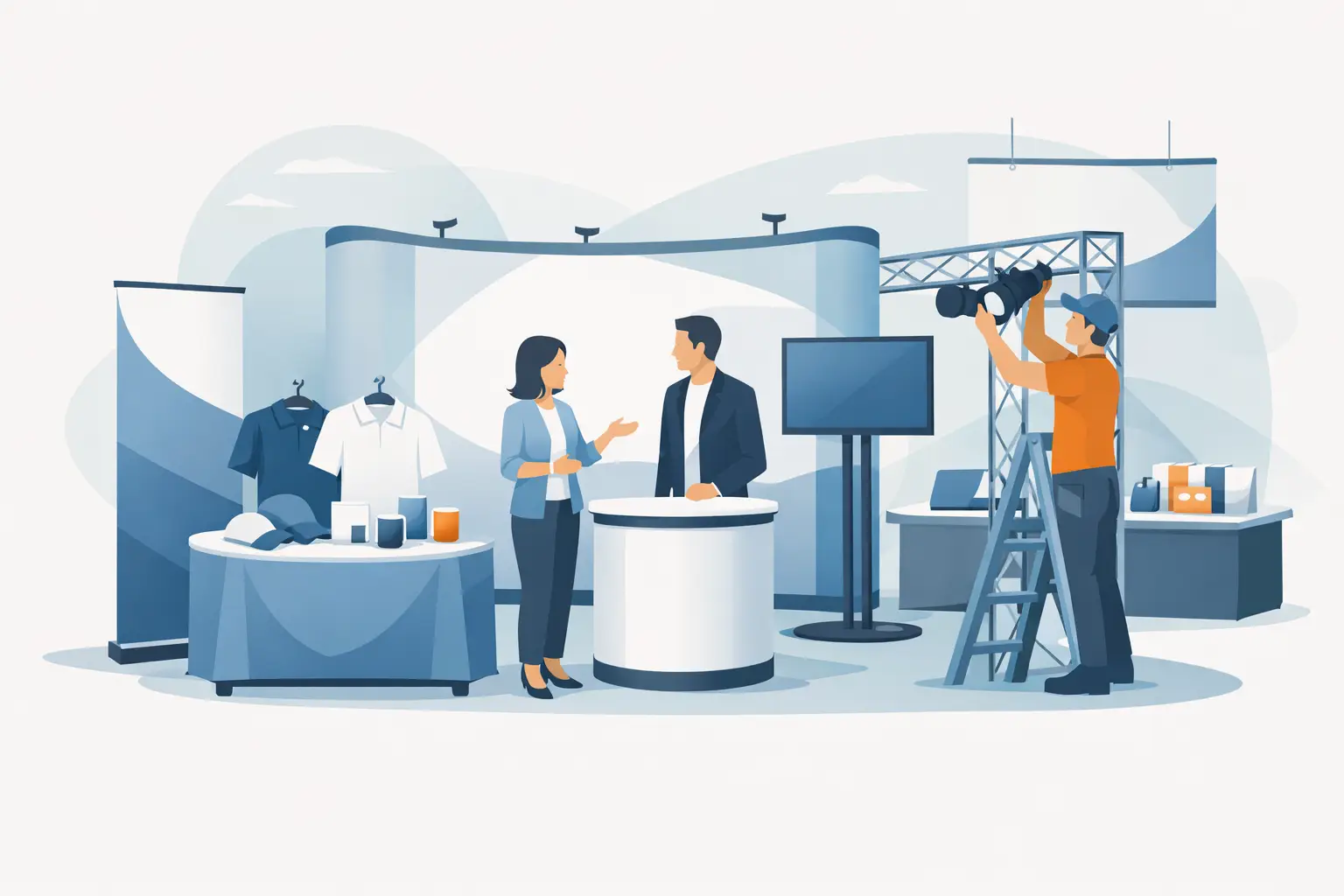
A busy exhibit hall gives attendees only a few seconds to decide whether your booth is worth a closer look. That is why a guide to trade show displays should begin with a practical question: what do you need people to understand, feel, or do when they see your space? The best display is not necessarily the biggest or most elaborate. It is the one that makes your message clear, gives your team room to connect, and supports a specific event goal.
For Kansas City businesses, schools, nonprofits, and community organizations, trade shows can mean anything from a large industry convention to a hiring fair, school activity night, municipal open house, or local business expo. The display should fit the audience, venue, budget, and frequency of use.
Need Custom Printing or Promotional Products?
Zepher Printing helps Kansas City businesses, schools, teams, and organizations with custom apparel, screen printing, embroidery, promotional products, and branded merchandise.
Request a QuoteStart With the Job Your Display Needs to Do
Before choosing a backdrop, banner, table cover, or giveaway, define the purpose of the event. A company focused on recruiting needs a different booth than a nonprofit seeking donors or a contractor looking for qualified project leads. Trying to communicate every service, product, and value at once usually creates a crowded display that people walk past.
Choose one primary objective. It may be booking appointments, collecting leads, introducing a new service, increasing awareness, recruiting employees, selling merchandise, or sharing information. Then build the display around that objective. A simple call to action such as “Schedule a Site Visit,” “Ask About Fall Registration,” or “Enter to Win” gives visitors a clear next step.
Your audience also changes the right approach. At a business-to-business show, concise proof points and polished printed materials may matter most. At a school or athletic event, bold colors, spirit wear, and a visually engaging setup can create energy. At a community event, approachable staff, easy-to-read signage, and useful takeaways often earn more attention than a complex booth structure.
Guide to Trade Show Displays: Choose the Right Format
A display format should match both your message and the way you will use it after the event. A lightweight setup may be the smarter investment for an organization attending several smaller events each year. A larger modular display may make sense when you regularly exhibit in convention centers or need a more immersive branded space.
Tabletop displays and fitted table covers
For career fairs, school events, nonprofit fundraisers, and local networking events, a branded table cover paired with a retractable banner can be highly effective. It creates a clean, professional footprint without requiring a large booth space. The table cover hides boxes and supplies below the table while placing your logo at eye level from across the aisle.
This format works best when your staff will be having one-on-one conversations. Keep the tabletop open enough for brochures, a sign-up device, product samples, or a few promotional items. Avoid filling every inch with literature that visitors are unlikely to carry home.
Retractable banners
Retractable banners are one of the most flexible tools in a trade show kit. They are easy to transport, quick to set up, and useful well beyond a single event. A banner can later support a lobby, presentation, recruiting event, open house, or retail promotion.
Use one banner for one main message. Large logo placement, a short headline, and a clean visual usually outperform a long list of services. If your organization needs more detail, let the conversation, handout, or QR code provide it. Tiny text may look complete during design review, but it will not work from six feet away.
Pop-up backdrops and modular displays
A pop-up backdrop creates a stronger visual presence when your booth has enough space and your brand needs to stand out in a crowded room. It is a good choice for companies with frequent trade show schedules, athletic programs hosting sponsor events, or organizations building a branded photo opportunity.
The trade-off is planning. Larger displays require storage, transportation, setup time, and graphics designed at the correct scale. Consider who will assemble it at 7 a.m. before the doors open. A display that looks impressive but is difficult for your team to manage can become a frustrating investment.
Outdoor and event signage
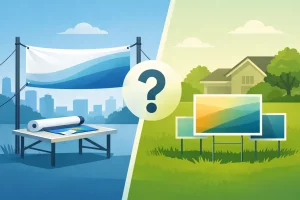
If your event takes place outdoors or across multiple rooms, directional signage may be just as valuable as the booth itself. Feather flags, yard signs, vinyl banners, and sandwich-board style signs can guide people to registration, a sponsor area, food service, or your display location. This is especially helpful for school tournaments, festivals, charity events, and municipal programs where visitors are moving through a large space.
Design for the Aisle, Not the Computer Screen
Trade show graphics must work at a distance. Visitors should recognize your organization and understand your core message before they reach the booth. Start with a clear hierarchy: logo, headline, supporting image or benefit, and call to action.
Use your established brand colors, typefaces, and imagery so the display feels connected to your website, apparel, business cards, vehicle graphics, and other materials. Consistency builds recognition. It also helps returning customers find you quickly at future events.
Photos should be high resolution and purposeful. A strong image of your team, finished work, student athletes, customers using a product, or a local project can make a display feel real. Stock-style visuals can work, but they should not replace the proof that makes your organization distinct.
Resist the temptation to place every logo, phone number, social handle, certification, and service line on the backdrop. When everything is emphasized, nothing stands out. If a visitor cannot describe what you do after a quick glance, simplify the message.
Build a Booth Experience, Not Just a Banner
Displays draw people in, but the experience determines whether they stay. Plan the booth as a working environment for your team. Leave enough open space for staff to stand comfortably, greet visitors, and demonstrate products or share materials without blocking the aisle.
Printed materials should support the conversation rather than replace it. A short capabilities sheet, event-specific flyer, product card, folder, or postcard gives visitors something useful to take with them. For organizations with several services, consider a concise overview piece and separate sheets for the services most relevant to that audience.
Promotional products work best when they are useful, relevant, and easy to carry. A well-chosen item can keep your name visible after the event, but it should fit the goal. Pens, drinkware, tote bags, notebooks, phone accessories, and branded apparel can all be effective depending on the audience and budget. A recruiting event may call for a practical welcome item, while a family-focused community event may benefit from something more interactive.
Have a lead-capture plan before the event starts. Decide whether you will use a sign-up form, tablet, badge scan, business card drawing, or QR code. More importantly, decide who will follow up and how quickly. A thoughtful message within a few business days is more valuable than a large list that sits untouched for weeks.
Plan the Details That Protect Your Investment
Even a well-designed booth can fall short when event logistics are overlooked. Confirm the booth dimensions, table size, electrical access, internet availability, setup window, height restrictions, loading instructions, and exhibit hall rules. If you have an end-cap or corner location, design the setup to use the extra visibility without creating a cluttered entrance.
Pack a small event kit with tape, scissors, clips, pens, charging cords, cleaning wipes, backup printed materials, and a method for storing leads. Bring more business cards and handouts than you expect to need, but do not overprint materials that include dates, pricing, or highly specific event details.
After the show, evaluate what worked. Did attendees understand your message? Which giveaway disappeared first? Did one banner attract more conversation than another? Were staff able to set up quickly? Those observations make the next event more effective and help you build a reusable display system over time.
A trade show display should make your team more confident, not give them one more problem to manage. For organizations across the Kansas City metro, working with an experienced local print partner such as Zepher Printing can help align signage, printed materials, apparel, and promotional products into one clear event presence. When the booth is prepared, the message is focused, and follow-up is ready, your team can spend the day doing what matters most: starting worthwhile conversations.